
Understanding Marion County Releases
A Marion County release is a change in custody status, not one standard event. A locally held person may leave after bond, dismissal, time served, a judge's order, or completion of a jail sentence. Another person may leave the same building because MDOC, another county, a federal authority, or immigration officials assumed custody. The second event is a transfer. It should not be described as freedom or a community release.
The distinction matters most at Marion/Walthall County Correctional Facility. It is a regional correctional facility in the MDOC network, operated through the local sheriff structure with state oversight. It may hold state prisoners as well as people under local authority. The source record should identify who held the person when the physical exit occurred. That answer determines whether the Marion jail docket, MDOC, a court, or another agency supplies the next record.
- Release
- A processed departure from a particular custodian, which may be to the community or another authority.
- Discharge
- Completion of the relevant sentence or jurisdiction, shown most firmly by an official certificate or status record.
- Detainer
- A request or authority that may cause another agency to take custody when local custody ends.
- ERS
- Earned-release supervision, a conditional community status in which the person remains under MDOC jurisdiction.
Marion County Release Types
The label beside a date tells what happened. Bond is not dismissal. Parole and ERS are not final discharge. Probation can begin through a court sentence without a state-prison exit. Each Marion County released inmate record should preserve the agency's own wording rather than turning every departure into the same broad term.
| Release type | Meaning and next source |
|---|---|
| Bond | The person left pretrial custody after bond conditions were met. Check the court order and jail discharge entry. |
| Time served or sentence end | The exit connects to a sentence or credit calculation. Confirm with the judgment and jail record. |
| Dismissal or court order | One case may no longer support custody, but another hold can remain. Review all known case numbers. |
| Parole or ERS | The person entered supervised community status under different legal authorities. Check MDOC, VINE, and Community Corrections. |
| Transfer or detainer pickup | Custody changed hands. Obtain the receiving agency and continue the search there. |
| Final discharge | The relevant correctional jurisdiction ended. Seek a discharge certificate or final official status record. |
A death in custody also ends a custody episode, but it must never be presented as an ordinary release. Likewise, a probation order describes court supervision and may not prove that someone physically left Marion/Walthall on the order date.
Note: A release date without its release type cannot show whether the person entered the community or remained in another agency's custody.
Marion County Release Record Fields
No single form contains every useful fact. The county trail can include a discharge line in the permanent jail docket, the booking sheet, a release authorization, a bond record, and a transfer entry. An MDOC trail can include a time sheet, parole action, ERS calculation, supervision entry, and discharge certificate. A court file may contain the order that authorized the change.
| Field to seek | What it establishes |
|---|---|
| Subject and identifier | The name plus booking number, MDOC ID, or another agency number connects the event to the right person. |
| Booking or entry date | The start of the custody episode documented by that custodian. |
| Actual release date and time | The processed departure, not merely the date of a court order or tentative estimate. |
| Release authority or type | Whether the event was bond, time served, dismissal, parole, ERS, transfer, or another outcome. |
| Court and case | The legal matter tied to the custody event and the order behind it. |
| Destination or receiving agency | Whether the person went to the community or remained confined elsewhere. |
| Supervision and custodian | The office responsible after conditional release and the agency that created the record. |
Names alone are weak matches. Compare an available date of birth, booking or corrections number, case number, county of conviction, and lawful physical descriptors. A middle initial, suffix, alias, or spelling change can otherwise make the correct Marion County record look absent.
Request Marion County Release Records
The Marion County Sheriff's Office provides the local historical route. Its official records page links a public-record request form and says the completed form must be mailed. A phone call can clarify current custody or procedure, but it does not replace the written request. Ask for existing records and a defined custody episode instead of asking staff to create a new narrative.
- Identify the person with full name and, if known, date of birth, booking number, arrest date, and a narrow date range.
- Request the jail-docket entry, booking or release sheet, and release authorization. Ask for the actual discharge date and time.
- Request the release type or authority and the receiving agency or destination if the entry says transfer.
- Ask for electronic copies if available, an itemized estimate before a chosen cost limit, and the authority for any withholding.
- Mail the form to Marion County Sheriff's Office, 219 Broad Street, Columbia, MS 39429, then preserve the response and production date.
The sheriff states that cost depends on staff time needed to research and gather records. It does not publish a flat release-record price. Under Miss. Code § 25-61-7, a public body may charge reasonable actual costs for search, review, duplication, and mailing, and it may require prepayment. A narrow request, electronic format, and cost cap can reduce expense.
Marion County Release Record Retention
Mississippi's local-government schedule creates a strong historical path after a Marion County released inmate vanishes from the web roster. The jail docket, series GSC 08-12, is permanent and includes the date of discharge. The inmate case file, GSC 08-13, is kept for 25 years after release. A jail census or meal log under GSC 08-11 can contain incarceration and release time, while cash-bond records have their own retention periods.
Request the series that fits the question. The permanent docket is best for the long-term fact of discharge. The case file may hold authorization, destination, property, or fuller booking documentation. A recent physical time may be found in the census or release-time entry. For disputed bond processing, ask for the cash-bond docket or receipt and the court's bond order.
Retention does not promise that every part is public. Lawful redaction, exemptions, juvenile confidentiality, sealing, and expungement still apply. A missing result can also reflect an identifier mismatch, a nonparticipating court, or a technical failure. It does not prove release, custody, or that no record ever existed.
Note: The permanent docket outlasts the current roster, but the records custodian still applies current law to each requested portion.
Mississippi Law on Marion Releases
The Mississippi Public Records Act, Miss. Code § 25-61-1 et seq., governs access subject to exemptions and agency rules. Section 25-61-5 generally calls for production within seven working days unless the public body's policy is shorter. If production cannot occur then, the body must give a particular written explanation. Without requester agreement, the statute sets the described outside limit at 14 working days from receipt.
Miss. Code § 99-19-71 provides several distinct expungement routes and exclusions. A lawful later search may omit a real historical booking after an eligible case is expunged. Youth Court and sealed materials are not ordinary public lookup sources. Do not reconstruct an expunged matter through old copies. When a denial or redaction seems unclear, ask for the cited legal authority and whether nonexempt parts can be separated.
Search Marion County Released Inmates
Start with custody authority, not a broad name search. The sheriff's current page is useful only for people it still displays. If the person entered MDOC, the state record becomes central. If a federal or immigration handoff occurred, the county roster is only the start of the trail.
- Open the official Marion inmate-records page and its JailTracker link. Treat a result as current display, not as a historical release archive.
- If the person is absent, call the sheriff and ask whether the outcome was community discharge or transfer. Request the permanent docket entry.
- Check Marion Justice Court or Circuit Court for the order, disposition, judgment, or case number behind the change.
- For state custody, search MDOC by exact ID where possible, then check parole status, VINE, and the local supervision office.
- For federal or immigration custody, use the matching federal locator and court docket. Confirm the next custodian rather than ending at a missing county result.
For a single known person, the full Marion County released inmate search depends on dates, identifiers, and source labels. For a same-day scan, the separate Marion County 24-Hour Releases page explains why there is no verified local feed and how to document the window.
MDOC Marion Release Search
The MDOC Inmate Search accepts first and last name or an MDOC number. The exact number is the stronger route. Open the detail record, compare neutral identifiers, and read the labels literally. Entry Date, Location, Unit, sentences, and Tentative Release Date describe the state record. County of conviction is not proof that the person was booked or released in that county.
| MDOC field | How to read it |
|---|---|
| Name or MDOC ID | Search inputs and identity anchors; exact ID reduces name collisions. |
| Entry Date and Location | State-system entry and current placement information, not a final discharge. |
| Sentence blocks | Offense, term, county of conviction, and sentence date for each listed sentence. |
| Tentative Release Date | An administrative estimate, not an actual historical exit certificate. |
| Parolees Search | A separate MDOC route that may support a current parole status. |
The official MDOC form can be seen at its source before searching.
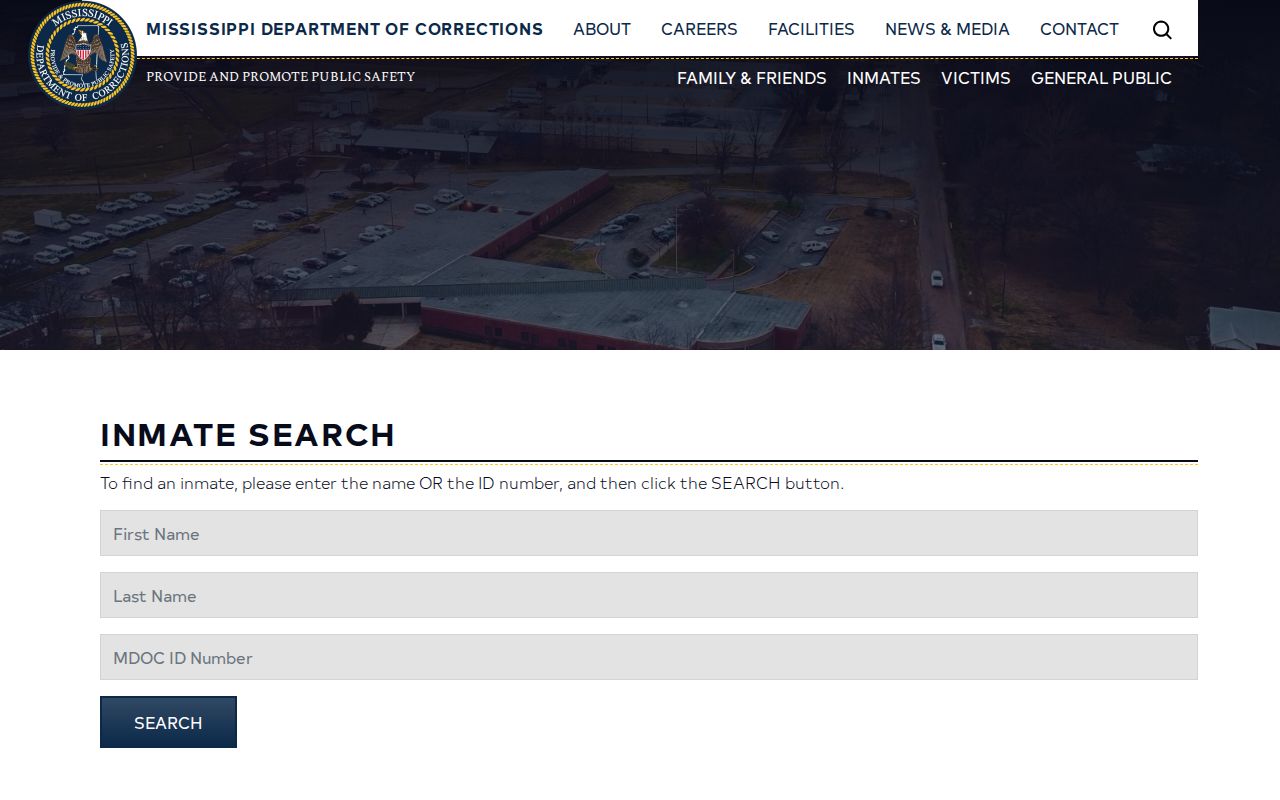
The captured page confirms the available name and MDOC-number path, while the detail record and discharge certificate supply different kinds of proof.
For a final answer, seek the discharge certificate or official status record. MDOC Records handles questions about time, jail credit, and eligibility. MDOC does not prove a bond-out or misdemeanor release that stayed wholly within Marion County, just as the county roster cannot show what happened after an MDOC transfer.
Marion Release Orders and Court Sessions
Marion Justice Court holds sessions at the jail three times each week to support timely initial appearances. This local rhythm explains why bond information can emerge from court before a web roster changes. It does not promise an exit on any set day. A bond order is legal authority; jail staff must still process bond and check for other holds.
The official Marion County courts page identifies Justice Court and the 15th Circuit Court. Justice Court handles county matters, DUIs, and the early stage of felony cases. Circuit Court is the stronger source for many felony dispositions, judgments, sentences, revocations, and later orders. Ask for the docket sheet and the specific order, then pair the court result with the jail's actual discharge or transfer entry.
A court label such as “disposed” does not itself mean sentence completion. Read whether the judgment imposed custody, time served, probation, suspended time, concurrent or consecutive terms, or another condition. One dismissed case can coexist with a second hold.
Marion Regional Facility Release Paths
Marion/Walthall's mixed role is the county's most important search boundary. A local detainee and an MDOC prisoner can occupy the same regional building yet create different release trails. County financial records also reflect revenue from agreements to hold inmates, which supports its regional function rather than a simple municipal holding model.
For a local detainee, begin with the Marion jail docket, booking or release record, and court case. For an MDOC prisoner, use the state offender search, VINE, supervision route, and discharge certificate. If either trail says transfer, obtain the receiving agency. “Left Marion/Walthall” does not answer whether the person returned to the community.
Note: No official evidence in the research establishes a federal prison, ICE detention center, or separate municipal lockup inside Marion County.
Marion Release Alerts and Supervision
Mississippi VINELink can help with a specific participating record and custody-change notifications. Open the matching record, read the named agency and exact status, and save the event details. VINE is a notification system, not the originating release certificate. Its update can follow agency processing, and a reported movement can be a transfer.
For parole, use MDOC's Parolees Search and the Marion Probation & Parole Office. Parole follows a State Parole Board decision. ERS is conditional release under MDOC jurisdiction. Probation ordinarily comes from a court sentence. An absence from a public search does not prove discharge or absconding, and no comprehensive public statewide MDOC absconder database was located.
Mississippi's sex-offender registry is a separate, limited post-release source for people legally required to register. It is not a list of Marion County released inmates generally. The local sheriff page explains registration after release or court direction.
Federal and Immigration Release Checks
The BOP Inmate Locator applies to federal BOP custody. A released federal record can show a release date and no-current-BOP-custody context, but it cannot resolve supervision, another warrant, immigration custody, or a new state case. PACER supplies federal court orders, judgments, and dispositions, subject to its account and fee rules.
ICE's locator is aimed at certain people currently detained in immigration custody. “Not found” is not a historical discharge certificate. A USMS detainee may be housed through a contract facility, so the charging court and counsel can be stronger sources than a public location search. These systems are contingency routes; none should be listed as a Marion County facility without official support.
Compare Marion Release Sources
Use the source that owns the status being tested. The live roster answers a current-display question. The permanent docket answers a past county discharge question. MDOC, courts, VINE, and federal sources each answer narrower questions.
- Still displayed locally: confirm the exact Marion County JailTracker and retrieval time.
- Gone from the roster: ask the sheriff for discharge versus transfer, then request the docket entry.
- In state custody: use MDOC Location, sentence data, parole status, and an official discharge record.
- Conditional release: identify parole, ERS, or probation and the responsible office.
- Federal or immigration handoff: use the relevant locator plus the court or receiving agency record.
Conflicts can reflect different event times. A court order may precede bond processing. A physical exit can precede a vendor update. MDOC may validate sentence and travel information before release. Ask what each timestamp means instead of assuming one source is wrong.
Marion County Release Facilities
The county map includes one regional correctional facility and two offices that support records or supervision. The offices are not extra jail buildings. Their roles differ, so the correct contact depends on the needed record.
- Marion/Walthall County Correctional Facility: use the county trail for a local detainee and MDOC for a state prisoner.
- Marion County Sheriff's Office: the principal local records-request and telephone fallback after a name leaves the roster.
- Marion Probation & Parole Office: the MDOC Community Corrections office for routing parole, probation, and ERS questions.
The sheriff's administrative address should not be treated as a second jail. Ask which authority held the person and which agency received them, if any.